KARNESH KNOWLEDGE / NAD+ / Part 1 / Understanding the evidence
What Is NAD+? What Human Research Can—and Cannot—Tell Us
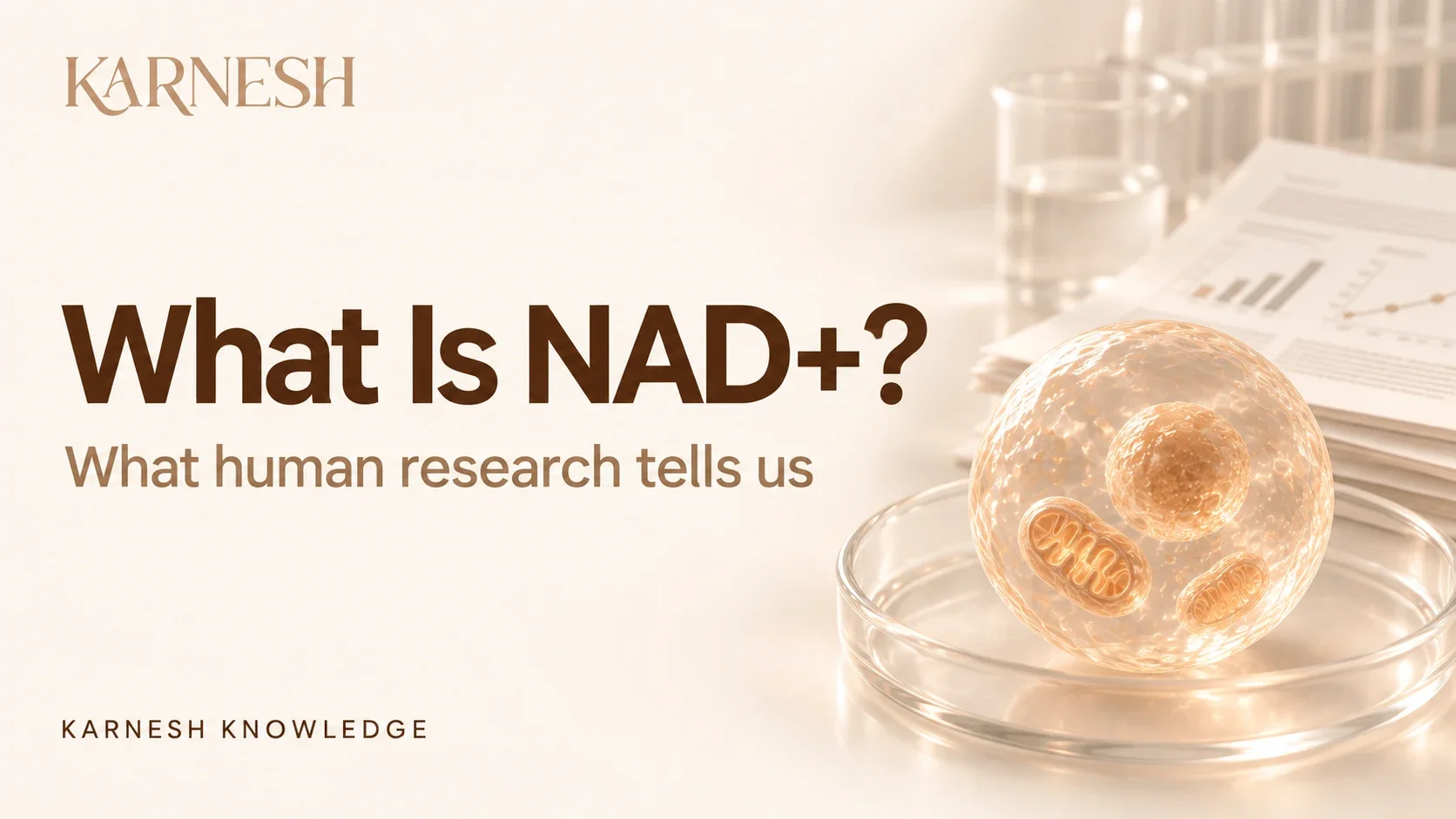
NAD+ is a coenzyme involved in cellular energy metabolism. Its role in the body does not, by itself, establish the benefits of giving additional NAD+. To interpret a claim, separate the compound, route of administration and outcome being measured. [1] [2] [3] [4]
What is NAD+?
NAD stands for nicotinamide adenine dinucleotide. The plus sign identifies its oxidized form. NAD works with enzymes in numerous metabolic reactions, including those involved in energy production. [1]
When reading that something is “important for cells," separate two questions: what does it normally do in the body, and does giving more of it through a particular route benefit a particular group of people? Answering the first question does not settle the second.
Read a study in three layers
Study question
Identify the intervention, population and measurements
Reported result
Separate a measured value from the health outcome of interest
Limits
Keep unanswered questions visible
Different studies answer different questions
Check the compound and route before interpreting a result. Intravenous NAD+, nicotinamide riboside (NR) and nicotinamide mononucleotide (NMN) are not interchangeable descriptions of one intervention. This article does not rank them or recommend a dose or schedule.
A useful reading framework is: who received what, by which route, for how long, and what was measured? If those details differ from the service being considered, avoid treating the result as evidence for that service. NIH resources on understanding health research offer further reading. [5]
Examples from human research
These examples illustrate differences between research questions. They are not a complete literature review or an endorsement of a clinic programme.
| Source | What was studied | Interpretation boundary |
|---|---|---|
| Grant et al., 2019 [2] | A pilot with 11 men: eight received IV NAD+ and three were controls. Blood and urine metabolites were assessed. | Short-term metabolism findings do not establish longer life or reversal of ageing. |
| Martens et al., 2018 [3] | Oral NR in healthy middle-aged and older adults, reporting increased NAD+ and tolerability in that study setting. | This was not an IV NAD+ trial. Its findings cannot directly establish IV outcomes. |
| Gallagher and Emmanuel, 2026 [4] | The abstract of a systematic review describes heterogeneous human health outcomes and inconclusive clinical effectiveness for anti-ageing and wellness. | Distinguish oral precursor findings from IV NAD+ and examine the review's inclusion criteria. |
What a change in NAD+ does not establish
When a graph shows an increase, ask whether it reflects blood or tissue, when it was measured, and whether the same study assessed the outcome that matters to the reader. Do not add outcomes that the study never measured.
For example, a short-term blood measurement should be described as such. It should not acquire an extra conclusion about lifespan without research that directly examines lifespan. An incomplete answer is a reason to state uncertainty, rather than to choose a confident claim.
For a consultation, “How does this finding relate to my health goal, and does it apply to people like me?" is a more useful starting point than “How large was the percentage increase?"
Questions to take to a consultation
You do not need to choose a programme from an article before speaking with a clinician. Consider taking these questions to a consultation:
- What goal are we assessing, and should other possible explanations be investigated first?
- Which compound and route are being proposed? Does the cited research match them?
- Which outcomes can reasonably be discussed, what remains uncertain, and what alternatives are available?
- Which conditions, medicines, supplements and allergies should I disclose?
- Who will assess me and supervise care? What happens if an unexpected symptom occurs?
- How and when will follow-up occur, and what does the quoted cost include?
This is a conversation checklist, not an individual suitability assessment or a complete list of contraindications. Seek appropriate medical assessment for symptoms and do not replace prescribed care with information from this article.
Frequently asked questions
Does NAD+ biology prove that an NAD+ infusion will improve my energy?
No. A biological role and a demonstrated service outcome are different questions. Evidence needs to match the intervention and measure the relevant human outcome. [1] [2] [3] [4]
Can oral NR research establish the benefits of IV NAD+?
Not directly. The compounds and routes differ, so the evidence needs to be matched to the intervention being assessed. [2] [3]
Does this article recommend a dose or treatment schedule?
No. It explains how to interpret evidence and prepare questions for a medical consultation.
Has this article been medically reviewed?
This article has not yet undergone medical review. It is educational information and does not replace an individual medical consultation.
Further reading and references
References
- NIH Office of Dietary Supplements. Niacin: Health Professional Fact Sheet.
- Grant R et al. (2019). A Pilot Study Investigating Changes in the Human Plasma and Urine NAD+ Metabolome During a 6 Hour Intravenous Infusion of NAD+. Front Aging Neurosci. 11:257. DOI: 10.3389/fnagi.2019.00257.
- Martens CR et al. (2018). Chronic nicotinamide riboside supplementation is well-tolerated and elevates NAD+ in healthy middle-aged and older adults. Nat Commun. 9:1286. DOI: 10.1038/s41467-018-03421-7.
- Gallagher C, Emmanuel OO (2026). NAD+ supplementation for anti-aging and wellness: A PRISMA-guided systematic review of preclinical and clinical evidence. Ageing Res Rev. 116:103057. DOI: 10.1016/j.arr.2026.103057. PMID: 41655607. Abstract consulted.
- NIH NCCIH. Know the Science: resources for understanding health research.
Continue reading and plan your questions
Use the evidence discussion to prepare questions for an individual clinical assessment.